Quick Answer
Clothes still smell musty even after washing? Human sweat has almost no smell of its own. Musty odor appears when bacteria living on our skin and in our fabric break down the sweat residue, sebum and dead skin cells left behind, and release odorous substances as waste. Washing fabric removes much of the bacteria substances and the number of bacteria, but if oily residue remains inside the fabric, bacteria multiply again quickly once the garment is worn. The solution that addresses the real cause is therefore not to mask the smell, but to make it difficult for bacteria to multiply on the fabric in the first place.
Key Takeaways
- Fresh sweat has almost no smell. The odor appears only after bacteria have started breaking it down.
- Fabric holds both moisture and oily residue, which together make excellent food for bacteria.
- The substances that cause the odor have names and can be measured, for example isovaleric acid and nonenal.
- Fragrance and fabric softener mask the smell temporarily, but do nothing about the cause.
Sweat Has No Smell, So Where Does the Odor Come From?
Sweat is the fluid the body releases to cool itself down. It is mostly water and mineral salts, and it has almost no smell.
The body has two kinds of sweat glands. The first kind is spread across the whole body and mainly releases a clear fluid. The second kind sits in areas such as the underarms and groin, and releases a fluid that also contains lipids and proteins. It is this second fluid that becomes food for the bacteria that live on our skin as a normal part of it. When bacteria break down those lipids and proteins, they release new substances, and it is those new substances that we actually smell.
Put simply, body odor does not come from sweat. It comes from what happens after the sweat is released.
Your Fabric Is Full of Food for Bacteria
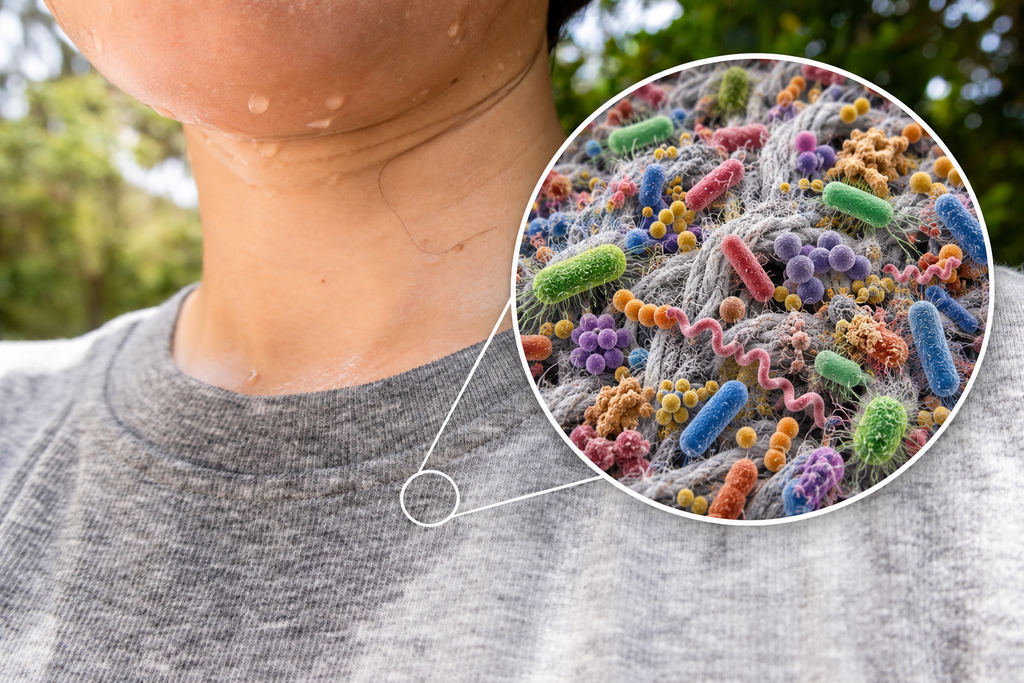
Once all of this seeps in between the fibers, the fabric becomes a comfortable place for bacteria, because it offers both food and moisture. The bacterial groups most commonly found and most directly linked to odor are Staphylococcus and Corynebacterium, which are already a normal part of human skin and are not foreign organisms from somewhere else.
Research on odor in sportswear also found that different fabrics hold oily residue to different degrees. Some synthetic fibers hold that residue more tightly, which is why some sports shirts start to smell sooner than a cotton garment worn on the same day.
The Smell We Notice Is the Waste That Bacteria Release
The substances behind musty odor are not a mystery. Researchers have identified them and can measure them in a laboratory.
The most familiar one is isovaleric acid, which gives the sour smell of socks worn too long. It is produced when bacteria on the skin break down an amino acid called leucine that comes out with sweat. The other is nonenal, which gives the stale, old smell. It is produced when lipids on the skin react with oxygen and change form. This kind of smell becomes more common with age, and it tends to cling to shirt collars, pillowcases and bed sheets.
Keep these 2 names in mind, because both are the substances actually measured in the test results discussed further below.
Why the Smell Returns After Washing, and Why Fragrance Does Not Help
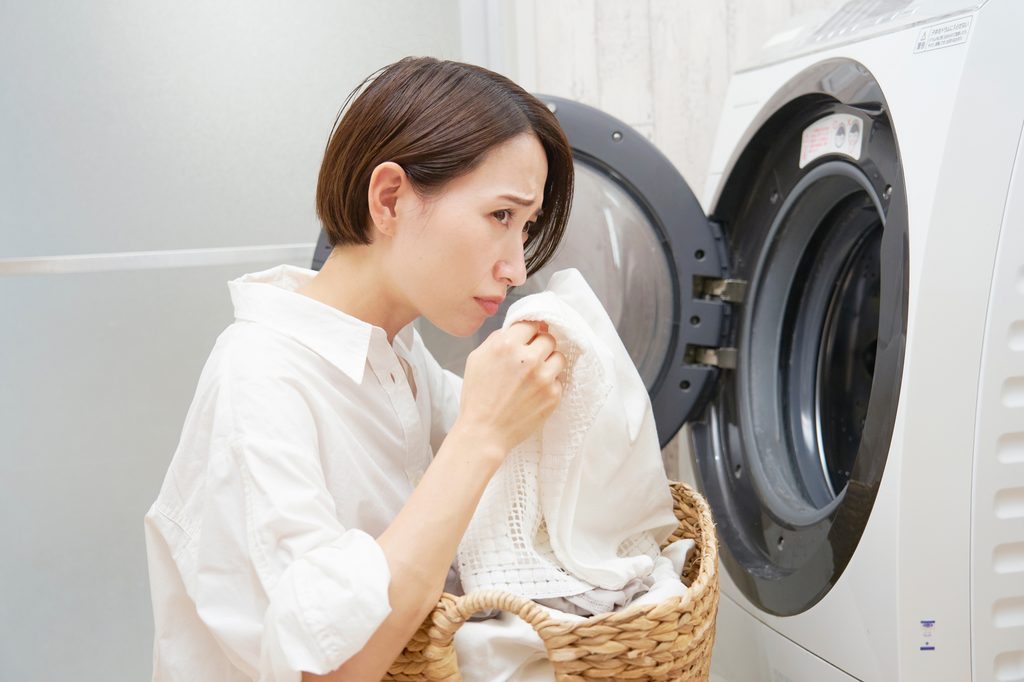
Washing does genuinely reduce both the residue and the number of bacteria, but it does not remove all of it every time. There are three reasons:
1. Oily residue that has worked its way deep into the fibers is hard to dissolve, especially in a cold wash, which is how most households wash.
2. Laundry that is not dried completely, or that is left sitting in the machine after the cycle ends, retains moisture that lets bacteria multiply again quickly.
3. When we put that garment on again, a fresh load of sweat and sebum goes right back into the same place.
Fragrance and fabric softener add a pleasant smell on top, which helps in the short term, but they do not reduce the number of bacteria or the residue that feeds them. Once the fragrance fades, the original smell returns, and sometimes the two smells mix into something even less pleasant.
Solving It at the Source: Making It Difficult for Bacteria to Multiply
If the odor comes from bacteria multiplying on fabric, the most direct solution is to make the fabric itself a place where bacteria find it hard to multiply.
PERMA® fiber works on this principle, inhibiting the multiplication of bacteria on fabric by embedding nano zinc particles into the body of the fiber during fiber production, rather than coating a substance onto the surface of finished fabric. When those particles come into contact with water and oxygen in the air, the reaction produces reactive oxygen species (ROS), which compromise the cell membrane of bacteria so that they cannot divide.
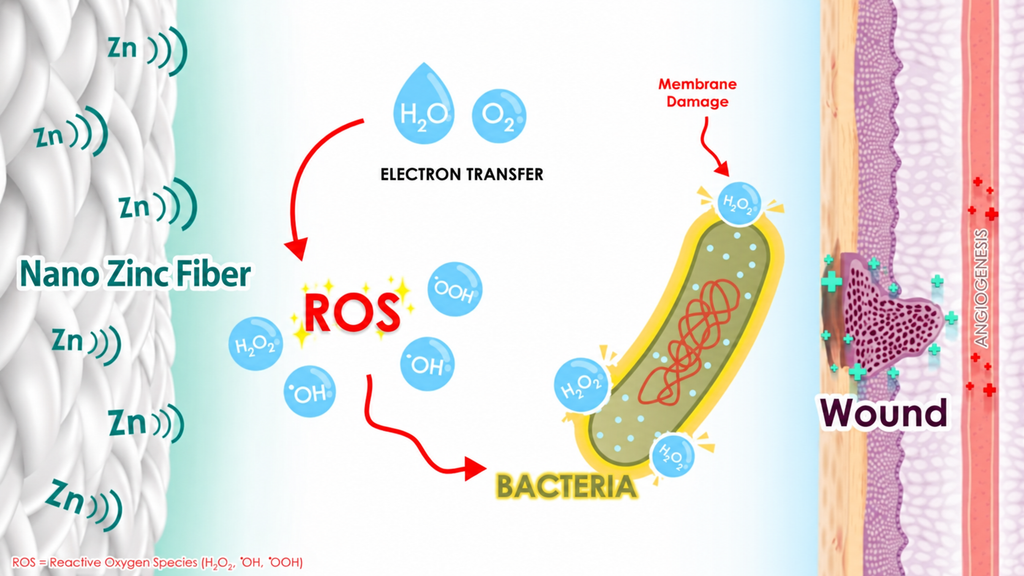
This point is important and worth understanding correctly. The mechanism does not act on bacteria directly the way a disinfectant does. It breaks the cycle by which they multiply. When damaged cells cannot divide and no new generation replaces them, the bacterial population on the fabric does not build up the way it does on ordinary fabric, and that is enough to deal with the odor, because the smell grows stronger as the number of bacteria increases.
The other important difference lies in the phrase embedded in the fiber. A substance coated onto the surface of fabric can flake away with washing and abrasion. Particles that sit inside the body of the fiber are not on the surface, so they do not flake away in that manner.
Test Results on Odor Itself
To measure how much odor is actually reduced, knitted fabric made from PERMA® fiber was sent for testing at BOKEN Quality Evaluation Institute in Japan.
The test used the JTETC method together with GC measurement, which measures the quantity of the odorous substances directly rather than asking people to smell samples and give scores. The results were a 99% reduction in isovaleric acid and an 88% reduction in nonenal, as recorded in report number BKKT17012557.
What is worth noting is that these two substances are the same ones described earlier. One comes from bacteria breaking down sweat residue, the other from lipids on the skin changing form. That means the test measures exactly the odor that people wearing clothes encounter in real life.
Is It Safe for Skin?
When fabric stays against the skin all day, the question of safety matters just as much as the question of odor.
PERMA® fiber has passed cytotoxicity testing to the ISO 10993-5 standard, carried out by the Faculty of Biomedical Engineering, Mahidol University, with a non-toxic result. This standard belongs to the same series used to evaluate materials that come into contact with the body in medical applications, so it is a stricter benchmark than ordinary textile testing.
It has also been certified to OEKO-TEX® Standard 100 at Class I, the level defined for textiles used for babies, and the level with the strictest requirements for residual substances in the system.
Does It Still Work After Washing?
This is the question where many odor-reducing fabrics on the market fall short, because a substance coated onto the surface of fabric gradually diminishes with the number of washes.
PERMA® fiber has been tested by the Thailand Textile Institute (THTI), with the result that it inhibits the multiplication of bacteria by more than 99% even after more than 150 washes. The figure of 150 washes has a practical meaning. If a shirt is washed once a week, 150 washes is almost three years, which is longer than the real service life of many garments in our wardrobes.
PERMA Fiber Test Results
| Test | Result | Institute or standard |
|---|---|---|
| Inhibition of bacterial multiplication after washing | More than 99%, even after more than 150 washes | Thailand Textile Institute (THTI) |
| Reduction of isovaleric acid odor | 99% | BOKEN Quality Evaluation Institute, JTETC method, GC measurement, report no. BKKT17012557 |
| Reduction of nonenal odor | 88% | BOKEN Quality Evaluation Institute, JTETC method, GC measurement, report no. BKKT17012557 |
| Cytotoxicity | Non-toxic | ISO 10993-5, Faculty of Biomedical Engineering, Mahidol University |
| Residual substances in textiles | Passed at Class I | OEKO-TEX® Standard 100 |
Summary
If you want to choose a fabric that genuinely deals with musty odor, use these three criteria to check for yourself.
1. Look at where the substance sits, coated on the surface of the fabric or embedded in the body of the fiber, because the position of the substance determines what remains after washing.
2. Look at how many washes the test results cover. A figure measured while the fabric is still new says very little. A figure after 100 washes or more says a great deal more.
3. Look at whether there is a separate test result for odor. Bacterial test results and odor test results are two different things, because odor is measured from the quantity of the odorous substances directly. A fabric that has both, together with the name of the testing institute, is a fabric you can trace back and verify.
FAQ
Does sweat really have a smell?
Fresh sweat has almost no smell, because it is mainly water and mineral salts. The smell appears after bacteria on the skin break down the lipids and proteins that come out with sweat and release odorous substances. The gap between sweating and first noticing a smell is the time during which the bacteria are at work.
Does drying clothes in the sun reduce musty odor?
It helps, but it is not a complete solution on its own. A 2016 study by a team at Rhine-Waal University, which tested different drying methods on contaminated laundry, found that every drying method significantly reduced the microbial load on the fabric, and that outdoor line drying gave the greatest effect.
This is consistent with work published in the Journal of Applied Microbiology in 2022, which noted that ultraviolet light from the sun contributes to the effect, and with a study of socks contaminated with fungi, which found that the group exposed to the sun for three consecutive days had significantly lower contamination than the group kept indoors.
The limitations are that sunlight acts mainly on the surface of the fabric and does not reach residue embedded deep inside, that folded or overlapping laundry does not receive light evenly, and that drying on a humid day, when the laundry never dries completely, can produce the opposite result.
Is fabric that inhibits bacteria safe for sensitive skin?
Look at the evidence rather than the advertising. The criteria you can verify are cytotoxicity test results to the ISO 10993-5 standard and OEKO-TEX® Standard 100 certification, particularly at Class I, the level defined for textiles used for babies and the level with the strictest requirements for residual substances.
PERMA® fiber passes both. Anyone with a specific skin condition should also consult a dermatologist.
What is the difference between coated fabric and fabric with the substance embedded in the fiber?
The difference lies in where the substance sits and what happens to it in the wash. Coating means applying a substance to the surface of fabric after weaving, so it can flake away with washing and abrasion.
Embedding means placing the particles inside the body of the fiber at the fiber production stage, so the particles are not on the surface and do not flake away in the same manner. The easiest way to check is to look at whether the manufacturer has test results after repeated washing.
References
- Mogilnicka, I., Bogucki, P., Ufnal, M. (2020). Microbiota and Malodor – Etiology and Management. International Journal of Molecular Sciences 21(8):2886. PMC7215946
- Chang, Y., Wang, X. (2023). Sweat and odor in sportswear – A review. iScience 26(7):107067. PMC10391722
- Brands, B., Honisch, M., Wegner, S., Bockmuhl, D.P. (2016). The effect of drying processes on the microbial load of laundry. Household and Personal Care Today, pp. 24-27. Rhine-Waal University of Applied Sciences
- Amichai, B., Grunwald, M.H., Davidovici, B., Shemer, A. (2014). The efficacy of sun exposure for reducing fungal contamination in used clothes. Israel Medical Association Journal 16(7):431-433. PubMed 25167689
- Reynolds, K.A. et al. (2022). Quantifying pathogen infection risks from household laundry practices. Journal of Applied Microbiology 132(2):1435-1448
- Ara, K. et al. (2006). Foot odor due to microbial metabolism and its control. Canadian Journal of Microbiology 52(4):357-364